

News
June 19, 2020
Picturesque Bethlehem Farm is Protected Forever
Connecticut Farmland Trust (CFT) is pleased to announce the preservation of Kuss Farm in Bethlehem. This 61-acre parcel of a 450-acre farm was protected in a joint effort by partners Connecticut Department of Agriculture, USDA-Natural Resources Conservation Services (USDA-NRCS), and CFT.
Dick and Peggy Ann Kuss began purchasing farmland decades ago to fulfill Dick’s lifelong dream of becoming a farmer. “My wife and I are eighty now, and we have forty years on the farm,” exclaimed Dick.”From a young age, I knew that I wanted to farm.”
Neither Dick nor Peggy were from farming backgrounds. Until they were nearly forty, the Kusses operated a school bus business. They made a career change as a couple but kept the school bus business going for a while for two farm-related reasons—so that Dick and Peggy would have income to buy additional farmland, and because school buses don’t run in the summer which allowed them to work the land during the growing season.
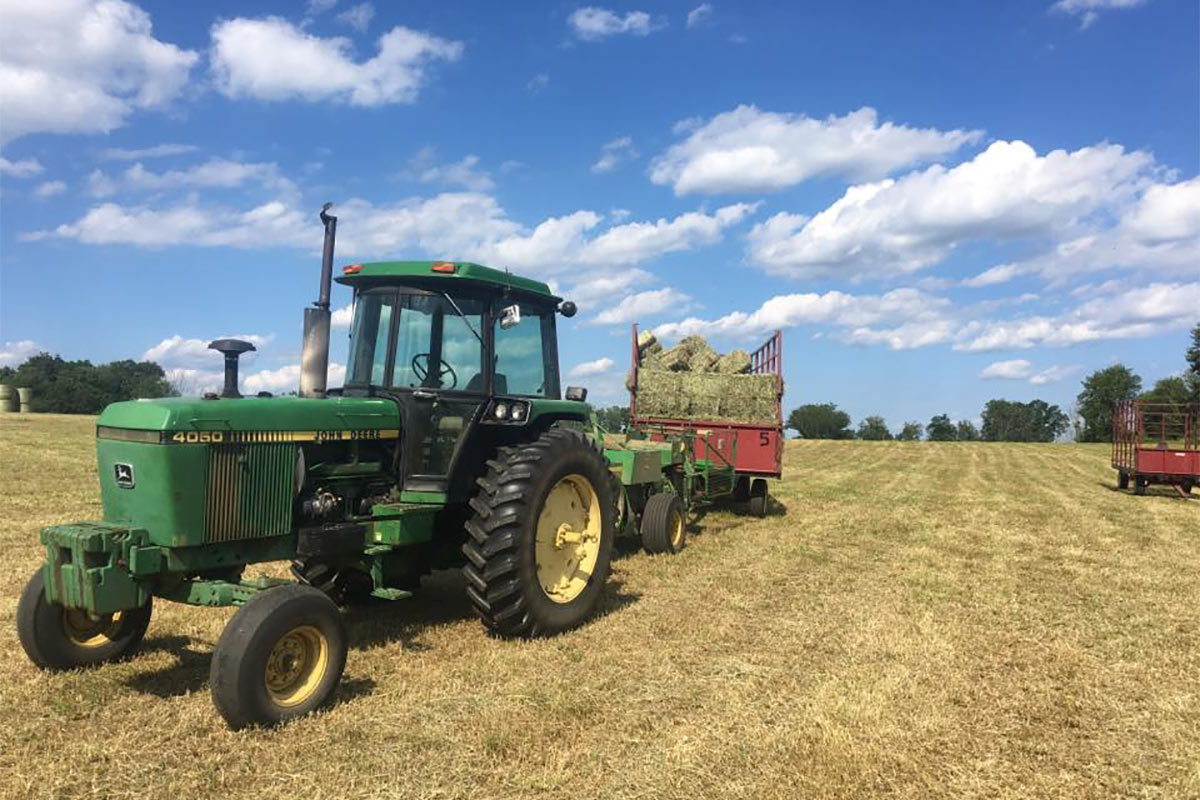
Today, the couple operates a regional, high-end hay business. Kuss Farm is the third-largest hay business in Connecticut. They sell and distribute hay for horses from other farms across Connecticut and New York. Kuss Farm also grows sweet corn, pumpkins, and vegetables for their roadside stand on Route 132 in Woodbury (the farm’s acreage is mostly in Bethlehem, but the stand is in Woodbury).
The Kuss family has already preserved two farm parcels through the CT Department of Agriculture’s Farmland Preservation Program; this is the third. When the Kuss family applied to the State to preserve this parcel, the State reached out to CFT to be a preservation partner. CFT and the State jointly secured an ACEP-ALE grant from the USDA-NRCS.
“We are grateful for the opportunity to partner with the Kuss Family to permanently protect this third parcel of agricultural lands,” said Agriculture Commissioner Bryan P. Hurlburt. “Through collaboration with our partners, we are able to ensure that this diversified farmland remains available to future farmers while meeting the needs of Connecticut now through the production and distribution of fresh vegetables and livestock feed.”
“Placing these 61 acres of the Kuss Farm under a conservation easement through our Agricultural Conservation Easement Program is another important step in our mission to protect the state’s valuable working lands,” said Thomas L. Morgart, Connecticut State Conservationist for the USDA-Natural Resources Conservation Service. “This farm contains some of the best soils in the state. Permanently protecting it and its high-yielding soils are of major importance in meeting Connecticut’s—and the nation’s—short- and long-range needs for food and fiber,” he said.
“Dick and Peggy Kuss are determined farmers who work tirelessly to maintain the farm and way of life that matters so much to them,” said Elisabeth Moore, Connecticut Farmland Trust Executive Director. “And thanks to them and their choice to protect their land now, it makes the Bethlehem region even more viable for the next generation of farmers. I have great respect for the family’s dedication to land protection, and it was a pleasure to once again work with the Connecticut Department of Agriculture’s Land Preservation Program and the USDA-NRCS on such a project.”
When asked about what is next for the farm, Dick said, “There are a lot of young people with an interest in farming, but they can’t farm because there is no land available for them. Maybe young people can use this farm in the future.” The Kuss family will continue to raise high-quality hay for the foreseeable future.
Agricultural conservation easements prohibit residential and industrial development but allow construction of agricultural structures on designated areas of the land. Since its founding in 2002, CFT has protected 57 family farms, covering over 4,400 acres. CFT is Connecticut’s only statewide land trust, and the only land trust in the state dedicated solely to the protection of agricultural land. CFT is a private 501(c)(3) nonprofit that relies on Connecticut residents to support its work.